

0грн.
CheckoutWHAT CHEESE INCLUDES
There are many variations of cheese plate. In the classic version, cheeses of six tastes should be present on a plate: fresh, neutral, pronounced, sharp and very sharp (sharpness is expressed in the richness of taste). Cheeses can also be classified by hardness and taste.
• Fresh and soft: ricotta, mozzarella, feta.
• Soft with a pronounced taste: brie, camembert.
• Semi-soft: gouda, edam.
• Solid: maasdam, emmental.
• Hard expressed: parmesan, gruyere.
• Acute with mold: gorgonzola, dorblu, roquefort.
According to the rules, a cheese plate should have at least five kinds of cheese.

ADDITIONAL INGREDIENTS
Fruits, nuts, berry sauces, honey and jam add to each grade of cheese additional shades of taste, help it open better.
Soft cheeses are ideal for pears and grapes. The universal companion fruit is fig.
Blue cheeses should be served honey or jam without pieces of fruit.
Add dried fruits to the sharp varieties: dates, raisins, dried apricots, prunes.
Nuts go well with any kind of cheese. Best suited walnuts, almonds and cedar.
Crackers and slices of fresh bread should be present on the cheese board.
HOW TO PUT EVERYTHING
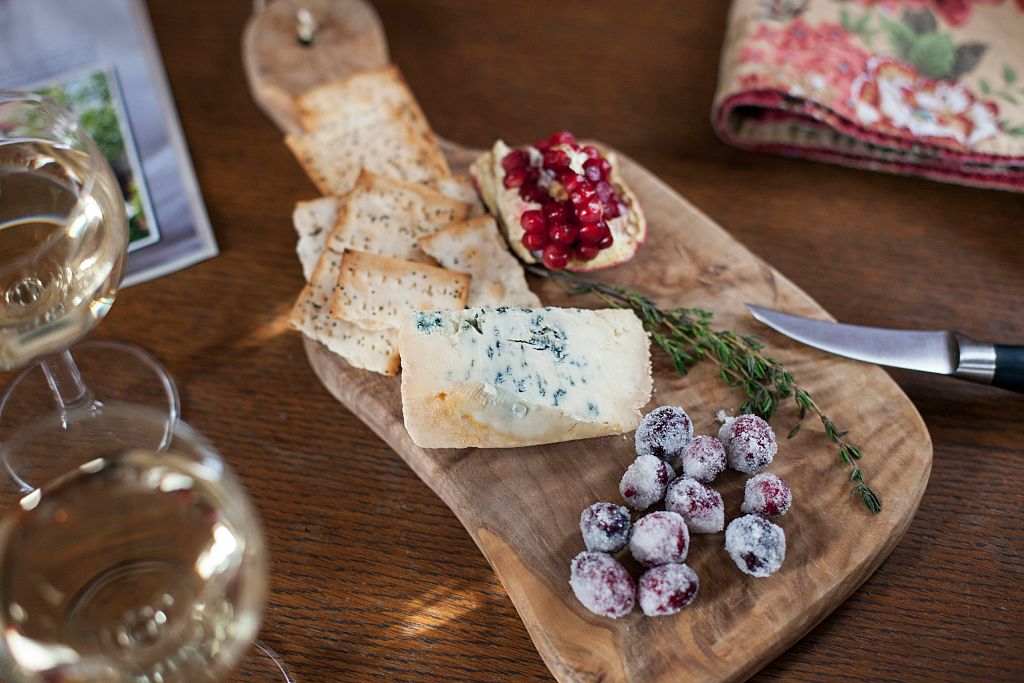
According to prevailing serving rules, cheeses are laid out clockwise from fresh to the sharpest. The softest cheese comes first (at 6 o’clock), followed by all the others. Interestingly, in the end, the most vivid opposites turn out to be the closest neighbors. Try to leave a small gap between aged and fresh cheeses so that the smell of the former does not drown out the light aroma of the latter.
The cheese board should be large enough so that each variety has enough space, because each of them has its own special smell, you do not need to mix them. For this perfect match our trays and scissors.
There is an alternative layout, when hard cheeses are placed on the edge, so that it is more convenient to cut them. And in the center are moist blue cheeses that crumble easily.